


Corporate Issuers CFA (Môn Tài chính doanh nghiệp)
Nội dung chính
Môn Tài chính doanh nghiệp (Corporate Issuers CFA ) được đánh giá là một chủ đề khá dễ, chiếm tỷ trọng khiêm tốn trong chương trình học CFA. Tuy nhiên đây sẽ là môn học nền tảng cho các môn học khác của CFA. Hãy khám phá môn học này trong bài viết bên dưới nhé!
1. Môn Tài chính doanh nghiệp trong từng level (Corporate Issuers CFA in 3 levels)
1.1. Trọng số môn Corporate Issuers CFA trong bài thi của các level
Môn Tài chính doanh nghiệp chỉ xuất hiện ở Level 1 và 2 với tỷ trọng cũng không quá cao nhưng số lượng công thức thì lại khá nhiều ở mỗi Level. Ta có thể thấy môn học này của Viện CFA mang tính định lượng khá cao.
| Level | Tỷ trọng | Số lượng câu hỏi | Số lượng công thức |
| Level 1 | 6-9% | Khoảng 16 | Khoảng 40 |
| Level 2 | 5-10% | 4-8 hoặc 1-2 câu hỏi tình huống | Khoảng 40 |
| Level 3 | 0 | 0 | 0 |
1.2. Chi tiết nội dung học của môn Corporate Issuers CFA trong các level
Corporate Issuers CFA Level 1
Ở Level 1, Viện CFA đưa ra 7 mô-đun cho môn Quản lý danh mục đầu tư (Corporate Issuers CFA):
| STT | Mô-đun môn học | Mô tả |
| 1 | Các hình thức tổ chức, đặc điểm của tổ chức hành doanh nghiệp và quyền sở hữu
(Organizational Forms, Corporate Issuer Features, and Ownership) |
|
| 2 | Nhà đầu tư và các bên liên quan khác
(Investors and Other Stakeholders) |
|
| 3 | Quản lý danh mục đầu tư: Tổng quan
(Corporate Governance: Conflicts, Mechanisms, Risks, and Benefits) |
|
| 4 | Vốn lưu động và thanh khoản
(Working Capital and Liquidity) |
|
| 5 | Đầu tư vốn và phân bổ vốn
(Capital Investments and Capital Allocation) |
|
| 6 | Cấu trúc vốn
(Capital Structure) |
|
| 7 | Mô hình kinh doanh
(Business Models) |
|
Tóm lại, CFA Cấp độ 1 Tài chính doanh nghiệp sẽ dạy bạn:
– những kiến thức cơ bản thực tế về tài chính, ví dụ khái niệm giá trị hiện tại ròng (NPV);
– cách quyết định nên đầu tư vào đâu.
– tại sao quản lý vốn lưu động lại quan trọng.
Corporate Issuers CFA Level 2
Tài chính donh nghiệp phần ở Level 2 có 4 mô-đun:
| STT | Mô-đun môn học | Mô tả |
| 1 | Phân tích cổ tức và mua lại cổ phiếu
(Analysis of Dividends and Share Repurchases) |
|
| 2 | Những cân nhắc về môi trường, xã hội và quản trị (ESG) trong phân tích đầu tư
(Environmental, Social, and Governance (ESG) |
|
| 3 | Các chủ đề nâng cao về chi phí vốn
(Cost of Capital: Advanced Topics) |
|
| 4 | Tái cơ cấu doanh nghiệp
(Corporate Restructuring) |
|
Xem thêm:
2. Mẫu câu hỏi & đáp án môn Corporate Issuers CFA trong các level
2.1. Câu hỏi Corporate Issuers CFA Level 1
Question 1:
Solution:
Modigliani-Miller propositions
| Without corporate taxes | With corporate taxes | |
| Proposition I: value of company (MM I) |
VL = V U | V L = V U + t D |
| VL = market value of leveraged company VU = market value of unleveraged company |
t = company’s marginal tax rate D = market value of debt |
|
| Proposition II: cost of equity capital (MM II) |
re = r0 + ( r0 – rd ) ( DE ) | re = r0 + ( r0 – rd ) (1 – t ) ( DE ) |
| r0 = weighted average cost of capital for 100% equity company t = company’s marginal tax rate r0 = cost of equity |
D/E = debt-to-equity ratio using market values for debt and equity rd = pretax cost of debt |
The Modigliani-Miller (MM) propositions assume perfect capital markets (ie, no arbitrage, no transaction or bankruptcy costs, and symmetric information) and assert that a company’s market value equals the present value of its future cash flows. Modigliani and Miller propose that, in the absence of taxes:
- A company’s capital structure does not affect its value (MM I without taxes); and
- A company’s cost of equity (re) is directly proportional to its debt-to-equity ratio (D/E), but WACC remains constant (MM II without taxes).
However, these propositions change when there are corporate taxes:
- The market value of a levered company is greater than the value of an unlevered but otherwise identical company; tax-exempt interest payments improve the levered company’s cash flows, increasing its value. The difference in value is the amount of the debt tax shield (tD), which is the product of a company’s tax rate (t) and value of debt (D) (MM I with taxes).
- A company’s re is directly proportional to D/E, adjusted by (1 − t). Greater leverage will increase the cost of equity, but at a slower pace due to taxes. The greater the tax rate (t), the slower the increase in re when D/E increases (MM II with taxes).
Therefore, with taxes, an increase in debt will proportionally increase a company’s value and reduce its WACC.
(Choice A) The MM propositions assume no cost of financial distress.
(Choice B) The market value would remain the same in the absence of taxes.
Things to remember:
The Modigliani-Miller (MM) propositions assume perfect capital markets (ie, no arbitrage, no transaction or bankruptcy costs, and symmetric information). When these propositions include corporate taxes, greater leverage will increase a company’s market value (MM I) and reduce its WACC (MM II).
Question 2:
Solution:

A key difference between the net present value (NPV) and internal rate of return (IRR) as criteria for valuing projects is the discount rates used in the reinvestment assumptions. The IRR assumes cash flows are reinvested at the IRR rate, and the NPV method assumes that cash flows can be reinvested in another project at that project’s required rate of return (ie, opportunity cost of funds).
The NPV’s reinvestment rate assumption is:
- more conservative, since the project’s rate of return will be lower than its IRR when NPV is positive, and
- more realistic, since it is unlikely that the company will be able to reinvest at that rate, assuming the company first pursues its more profitable opportunities.
Since the NPV uses the more conservative and realistic reinvestment assumption, a company ranking mutually exclusive projects should prioritize based on the NPV.
(Choice A) If a project’s projected cash flows are conventional (ie, negative outlay followed by cash inflows), there will be only one IRR. In this scenario, since both projects have conventional cash flows, there is no risk of multiple IRRs.
(Choice B) The same cash flow projections are used and are equally difficult to generate whether an NPV or IRR is used to analyze investment projects.
Things to remember:
A key difference between the net present value (NPV) and internal rate of return as criteria for valuing projects is the discount rates used in the reinvestment assumptions. A company ranking two mutually exclusive projects should prioritize the NPV method since it has the more conservative reinvestment assumption.
2.2. Câu hỏi Corporate Issuers CFA Level 2
Passage:
Compass Engineering’s board of directors is deciding between cash dividends or a share repurchase program as a method to begin returning cash to shareholders. Liam Fischer, a member of the board, states that both cash dividends and share repurchases have certain advantages that should be considered:
Advantage 1: Share repurchases tend to be more flexible. Although dividends can be raised, lowered, or suspended, they appear to create an expectation among investors that the distribution will continue in the future. Share repurchases do not seem to create the same expectation.
Advantage 2: If the tax rates for capital gains and dividends are the same, and the information coefficient is the same, then shareholders’ wealth will be greater with cash dividends since all shareholders receive cash.
Alicia Wu, the chairman of the board, indicates that Compass should review the long-term trends in the country (the United Kingdom) before deciding.
After deliberation, the board favors a share repurchase program. Jessica King, another member of the board, is concerned about the effect of share repurchases on Compass’ EPS. She collects the following data for 20X2:
| Exhibit 1 Compass’ Financial and Market Information for Proposed Share Repurchases | |
|---|---|
| Net income (Millions) | £650 |
| Cash on hand (Millions) | £500 |
| Shares outstanding (Millions) | 100 |
| Current share price | £115 |
| Expected purchase price | £125 |
| Pretax cost of debt | 6% |
| Tax rate | 20% |
In addition, King wonders what effect share repurchases have on companies’ book values. She gathers data from three of Compass’ peers who have made a share repurchase:
| Exhibit 2 Financial Information on Compass’ Peers | ||||
|---|---|---|---|---|
| Peer 1 | Peer 2 | Peer 3 | ||
| Net income | 150 | 300 | 350 | |
| Book value of equity | 3,000 | 5,000 | 6,500 | |
| Shares outstanding | 500 | 600 | 650 | |
| Value of shares repurchased | 90 | 80 | 310 | |
| Number of shares repurchased | 15 | 10 | 30 | |
| After-tax cost of debt | 5.5% | 6.0% | 5.0% | |
The board members then discuss the best approach for Compass to repurchase shares. King has identified two possible scenarios, both using the same amount to repurchase shares: Scenario 1: Purchase shares using all cash on hand. Scenario 2: Purchase shares with funds from an issuance of debt. Wu states that her preference is to choose a method by which the company can control the process and execute it quickly. She also prefers a process that would allow Compass to discover the minimum price at which it can repurchase the desired number of shares.
Question 1:
Solution:
| Potential benefits of repurchases vs. dividends |
|---|
|
In theory, dividends and share repurchases are equivalent in their effect on shareholder wealth, all else equal. Both forms of shareholder returns transfer corporate wealth to shareholders as cash, which:
- effectively lowers the value of the company (and its shares), and
- results in overall shareholder wealth remaining the same since the shareholders’ receipt of cash is balanced by a decrease in share value, all else equal (Choices B and C).
In practice, dividends and share repurchases can have advantages over each other. A major advantage of dividends is that repurchases may be legally restricted in some jurisdictions. However, the potential benefits of share repurchases include greater flexibility for managers:
- Repurchases do not create the investor expectations of continuity that dividends do.
- Companies are not obligated to execute a complete share repurchase program.
- The timing of share repurchases is at the managers’ discretion.
Investors have different expectations of regular cash dividends and share repurchases; therefore, share repurchases are more likely viewed by investors as a substitute for special, not regular, cash dividends.
Things to remember:
In theory, dividends and share repurchases have an equivalent effect on shareholder wealth, all else equal. However, repurchases provide greater flexibility for managers, due in part to repurchases not creating the same investor expectations of continuity that dividends generate.
Question 2:
Solution:
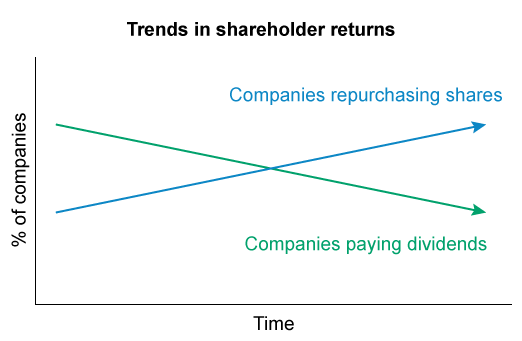 Over time, companies in several developed (ie, resource rich) nations have trended in similar directions regarding their approach to shareholder returns. In many developed markets (eg, United States, Canada, United Kingdom, European Union, Japan), the fraction of companies paying cash dividends has been in decline (Choice C). At the same time, the fraction of companies engaging in share repurchases in those markets has increased.
In this question, Compass Engineering is based in the United Kingdom, where the most likely trends are that a lower proportion of companies pay dividends and a higher proportion repurchase shares.
(Choice B) In several studies focused on multiple developed nations, for companies paying dividends, aggregate dividend amounts and payout ratios have increased over time. Companies paying dividends tended to be larger and more profitable but also more mature, meaning they have fewer growth opportunities and lower research and development spending.
Things to remember:
In many developed markets, the fraction of companies paying cash dividends has been in decline. At the same time, the fraction of companies engaging in share repurchases in those markets has increased. Although the proportion of companies paying dividends has declined, aggregate dividend amounts and payout ratios have increased for those companies.
Xem thêm:
[Cập nhật] Bóc trần cấu trúc đề thi CFA: Đừng bỏ lỡ bất kỳ điểm nào!
Bài tập Corporate Issuers CFA (Môn Tài chính Doanh nghiệp CFA) kèm đáp án
3. Một số mẹo học và ôn thi môn Corporate Issuers CFA
- Tài chính doanh nghiệp là kiến thức cơ bản nên hãy học nó thật chắc: Hầu hết chương trình giảng dạy CFA ở mọi cấp độ, cuối cùng đều quay lại môn học này vì các kiến thức về sau đều có liên quan ít nhiều đến các phần kiến thức của nó
- Luyện tập bám máy thật nhiều. Bạn chắc chắn sẽ gặp phải các câu hỏi về NPV. Tìm hiểu cách sử dụng hiệu quả các chức năng cần thiết của máy tính sẽ giúp bạn xử lý những câu hỏi nhanh hơn.
- Hiểu sâu ý nghĩa của các công thức: Môn học này sẽ không chỉ dừng lại ở việc bạn biết sử dụng công thức mà phải hiểu gốc rễ của nó, ưu nhược điểm, các trường hợp có thể sử dụng công thức, ngắn hạn hay dài hạn. Chúng đều là những phần kiến thức quan trọng cần phải nắm được để trả lời tốt các câu hỏi của Viện.
Câu hỏi thường gặp
Tổng quan về Tài chính doanh nghiệp (Corporate Issuers CFA)
Phần Corporate Issuers của kỳ thi CFA đào sâu vào việc đánh giá quản trị doanh nghiệp và hiểu biết về cách các công ty điều hướng các quyết định đầu tư và tài trợ. Mặc dù có trọng số tương đối khiêm tốn, các khái niệm được học trong Tài chính doanh nghiệp sẽ tạo thành nền tảng của kiến thức tài chính doanh nghiệp trong suốt Chương trình CFA.
Môn Tài chính doanh nghiệp (Corporate Issuers CFA) có khó không?
Corporate Issuers thường được coi là chủ đề CFA dễ hơn. Các công thức khá trực quan và các khái niệm phần lớn dựa trên tài liệu được đề cập trong các chủ đề khác. Tuy nhiên, mức độ dễ tương đối của Corporate Issuers phụ thuộc vào sự hiểu biết của ứng viên về các khái niệm, công thức.
Chứng chỉ CFA có hữu ích cho các tổ chức phát hành không?
Có, điều lệ CFA hữu ích cho các công ty phát hành chứng khoán–và ngược lại. Các ứng viên sẽ nghiên cứu các nguyên tắc cơ bản để đánh giá các quyết định đầu tư và tài trợ của công ty trong chủ đề Công ty phát hành chứng khoán cấp độ CFA. Các chủ đề CFA còn lại cung cấp nền tảng hoặc mở rộng kiến thức thu được trong chủ đề Công ty phát hành chứng khoán.
Ngoài ra bạn có thể theo một khóa học về chứng chỉ CFA, nơi có thể giúp bạn định hướng và cung cấp đầy đủ tài liệu ôn thi. Nếu bạn đang cần tư vấn về lộ trình học và ôn tập CFA, đừng ngần ngại liên lạc với Taca Academy!
- Khóa học CMA luyện thi Chứng chỉ Kế toán quản trị Hoa Kỳ (U.S CMA)
- DipIFR – chứng chỉ lập báo cáo tài chính quốc tế (Level 2)
- Chuyển đổi báo cáo tài chính từ VAS – IFRS
- Khoá học IFRS toàn diện (CertIRF, DipIFR, VAS to IFRS)
Taca International Certificate,



ĐĂNG KÝ TƯ VẤN KHÓA HỌC
Vui lòng để lại thông tin liên lạc để chúng tôi có thể tư vấn rõ hơn về các khóa học
Trụ sở chính
Tầng 2 Toà A Chelsea Residences, Số 48 Trần Kim Xuyến, Q. Cầu Giấy, TP. Hà Nội
Hotline: 0985 611 911
Chi nhánh
Vincom Đồng Khởi, Quận 1, TP. HCM
Hotline: 0947 511 911